What happens at a show jumping competition: 7 steps from arrival to rosettes
 Save
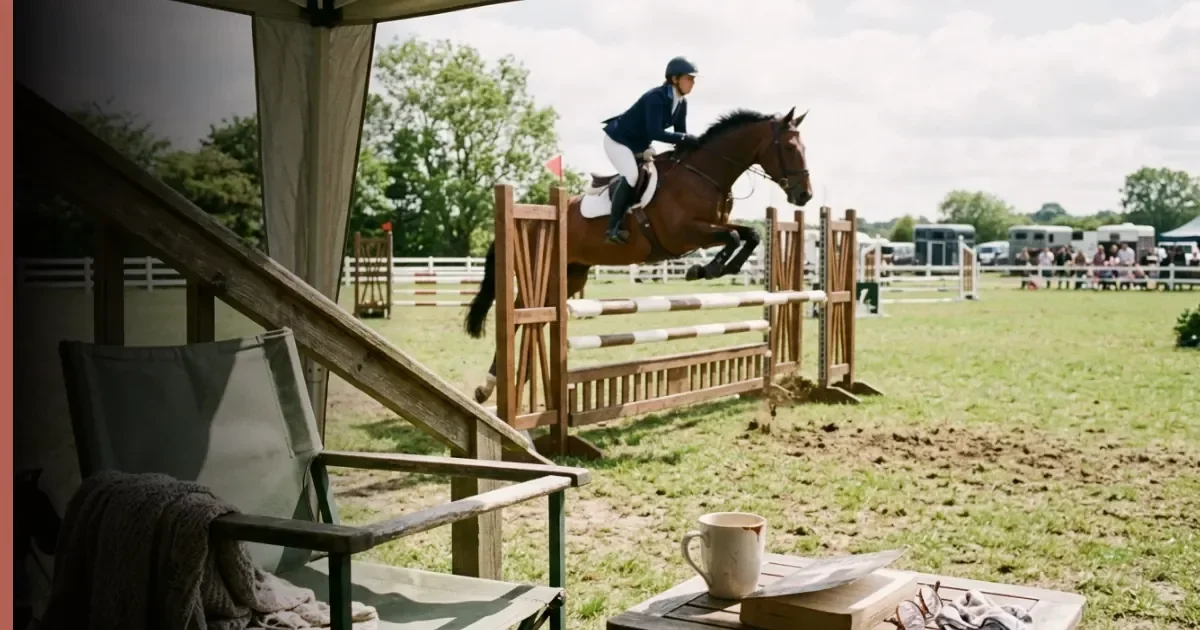
A show jumping competition is an event where horse and rider navigate a course of coloured fences against the clock, aiming for a clear round with no poles down. Area 18 Riding guides you through what to expect on the day. By the end you'll know when to arrive, how the class runs and what happens if you knock a fence.
Arriving at the showground
Plan to arrive at least an hour before your scheduled class time. Most venues have a car park for lorries and trailers close to the stables or warm-up area. You'll need your horse's passport and proof of membership if the competition is affiliated.
Find the secretary's tent or office first. This is where you collect your number, confirm your entry and pay any outstanding fees. The running order is usually displayed on a board nearby, showing which class is in the arena and how far through the list they've reached.
Registration and collecting your number
At the secretary's desk, give your name and the class you've entered. They'll hand you a number bib to attach to your back with string or elastic. Some competitions use electronic timing, so you may also receive a small timing chip to fasten to your bridle.
Ask about the course map if it's not already posted. The secretary can tell you if your class is running on time or delayed. Write your start time on your hand or phone so you don't miss the call.
Walking the course
Before any jumping begins, competitors walk the course on foot to memorise the route and assess each fence. The bell or whistle signals when the arena is open for walking. You'll see the fences numbered in the order you'll jump them.
Count your strides between combinations—two or three fences placed close together with one or two strides in between. Notice the turns: a tight corner after a vertical needs a steadier approach than a long gallop to a spread. Stand behind each fence to see what your horse will see, especially if there's a filler or a brightly painted pole.
What to look for on your walk
- The start and finish markers, which trigger the timing
- Any changes of rein or tricky angles between fences
- The ground conditions—wet patches or deep going near a fence
- Where the sun is, in case glare affects your horse's view
Warming up before your class
The warm-up arena is where you prepare your horse for the course. Arrive with enough time to loosen up, practise a few fences and settle any nerves. Most shows provide a cross-pole, an upright and a spread for schooling.
Keep your warm-up short—ten to fifteen minutes is usually enough. Jump each practice fence two or three times at the height of your class, then walk on a long rein to let your horse relax. If the warm-up is crowded, call out which fence you're approaching so others can stay clear.
Your round in the arena
When the steward calls your number, ride into the arena and salute the judge if required. The bell rings to signal you can start. You have a set time—often forty-five seconds—to cross the start line, or you'll be eliminated.
- Cross the start markers at a working canter to begin the clock.
- Approach the first fence in balance, keeping a steady rhythm.
- Ride the turns you walked, adjusting your pace for tight corners or long approaches.
- If a pole falls, keep going—the round isn't over until you cross the finish.
- After the last fence, pass through the finish markers to stop the clock.
- Leave the arena at walk unless the steward directs you otherwise.
A clear round means no poles down and no refusals. If several riders go clear, a jump-off decides the winner: a shortened course ridden against the clock. The fastest clear round in the jump-off takes first place.
Faults, refusals and what they cost
Each knocked pole adds four faults to your score. A refusal—when your horse stops or runs out at a fence—also costs four faults, and you must circle back to try again. Three refusals in one round results in elimination.
| Error | Penalty | What happens next |
|---|---|---|
| Pole down | Four faults | Continue to the next fence |
| First refusal | Four faults | Circle and re-attempt |
| Exceeding the time allowed | One fault per second over | Round complete, faults added |
| Fall of horse or rider | Elimination | Leave the arena |
Time penalties apply if you take longer than the allowed time for the course, which is posted on the running order. Every second over adds a quarter or one fault, depending on the rules of the class.
Results and prize-giving
Scores are displayed on a board or announced over the loudspeaker after each round. If you're in the top placings, the steward will call you back for the prize-giving once the class finishes. Line up in the arena in reverse order—sixth place enters first, the winner last.
Rosettes are handed out by the judge, sometimes with a sash for first place. Stay mounted and walk forward when your name is called. A clear round in your first competition is worth celebrating, whether you place or not.
What to do after your class
Walk your horse until it's cool and breathing normally. Offer water in small amounts if the day is warm. Untack, check for any rubs or swelling, and load up calmly. Many riders stay to watch other classes or walk another course if they've entered more than one event.
Keep your number bib—some venues ask you to return it, others let you take it home. Write down what went well and what you'd change next time while the round is fresh in your mind. Every competition teaches you something, and the next one will feel less daunting.
Download PDF: Your first show jumping competition checklist PDF, 30 KB
Further reading
Frequently asked questions
Do I need to qualify to enter a show jumping competition?
Most unaffiliated competitions are open to anyone without prior qualification. Affiliated classes may require your horse to be registered and you to hold membership with the governing body, but newcomer and grassroots levels usually have no height or grading restrictions.
What happens if my horse refuses a fence during the round?
You receive four faults and must circle back to re-attempt the same fence. After three refusals in one round you are eliminated and must leave the arena. If you clear the fence on the second attempt, you continue the course as normal.
How long does a typical show jumping class take from start to finish?
A class with twenty to thirty entries usually runs for one to two hours, depending on how many clear rounds lead to a jump-off. Each individual round lasts one to two minutes, with short intervals between riders as the next competitor enters and the course is checked.
Can I watch the course being built before I walk it?
Yes, the course is set up before the class begins and remains visible while earlier classes finish. Watching the build gives you an idea of the height and spread of each fence, though you cannot walk the course until the arena is officially opened for competitors.
What should I wear for my first show jumping competition?
Wear a correctly fitted riding helmet meeting current safety standards, jodhpurs or breeches, long boots or jodhpur boots with half chaps, and a plain shirt or riding jacket. Unaffiliated shows are more relaxed about turnout, but a tidy appearance and safe equipment are expected at all levels.
Do I need my own horse to compete in show jumping?
You can compete on a horse you loan, hire or borrow, provided you have the owner's permission and the horse is fit and insured. Some riding schools enter their horses in competitions with regular riders, and share schemes often include competition outings as part of the arrangement.
What is a jump-off and when does it happen?
A jump-off is a tiebreaker round for riders who finished the first round with equal top scores, usually all clear or all on four faults. The course is shortened and ridden against the clock. The fastest clear round wins, or if no one goes clear, the fastest time with the fewest faults takes first place.